Get ready for your license test with AI assistance!
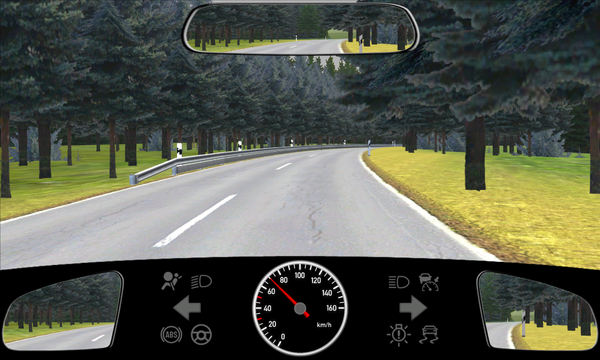
What should you anticipate in this situation?
Slow-moving vehicle on my side of the road
Fast oncoming traffic cutting the corner
Wild animals crossing the road
Here is Our AI Assistant's Explanation
All three anticipations are correct because this is a rural, wooded bend with limited visibility. In German driving theory, the key rule is: when you cannot see far enough ahead (especially in curves), you must always be prepared for hazards on your lane and for oncoming traffic not staying perfectly in its lane.
Answer 1 (slow-moving vehicle on your side) fits because behind a bend you can suddenly meet a tractor, forestry vehicle, cyclist, or a car turning/starting slowly. Since your sight distance is short, you must be able to brake within the distance you can see to be clear.
Answer 2 (fast oncoming traffic cutting the corner) is a common curve risk. Drivers coming from the opposite direction may “straighten” the bend and briefly cross the center line, especially if they are too fast or misjudge the curve. That means you should keep to the right and not “use” the center line yourself.
Answer 3 (wild animals crossing) is typical in forest areas. Animals can appear suddenly and unpredictably, often in groups. The practical takeaway is to reduce speed early, scan the verge, be ready to brake, and avoid risky swerving into the opposite lane.